Does It Snow in Spain?


This post may have affiliate links, which means we may receive a small commission (at no extra cost to you!) if you choose to purchase through them. Here’s our Disclosure & Privacy Policy for more info.
Wondering, Does It Snow in Spain?
Surprisingly, yes, it does snow in Spain. Spain is one of the most climatically diverse nations globally, with five major climate zones.
Yes. It snows in Spain.
Often when we think of Spain, we think of the “Mediterranean” climate with mild weather all year round.
But Spain’s Mediterranean climate is only active throughout roughly one-fifth of the country.
Only one-fifth of Spain enjoys a Mediterranean climate.
Spain is an elevated plateau, which means its winters are extremely cold.
According to the World Atlas, any region with an elevation of at least 4,900 feet will most likely receive snow.
What Is the Coldest Month in Spain?
January is typically the coldest month in Spain and it snows heavily in the mountainous regions like the Pyrenees.

February can also be quite cold in northern Spain, with temperatures below freezing.
Spain’s Climate Is Different From Central and Northern Europe
Spain is relativity dry compared to countries like France and Germany, so snowfall is not constant, and there’s usually less participation that comes along with it.
However, temperatures can get very cold.
There have been times when snowfall in Spain has been significant, as in February 2018, when Barcelona got so much snow it stopped traffic and other normal daily activities.
Spain’s mountain regions – the peaks of the Sierra Nevada and the Pyrenees are constantly capped with layers of snow.
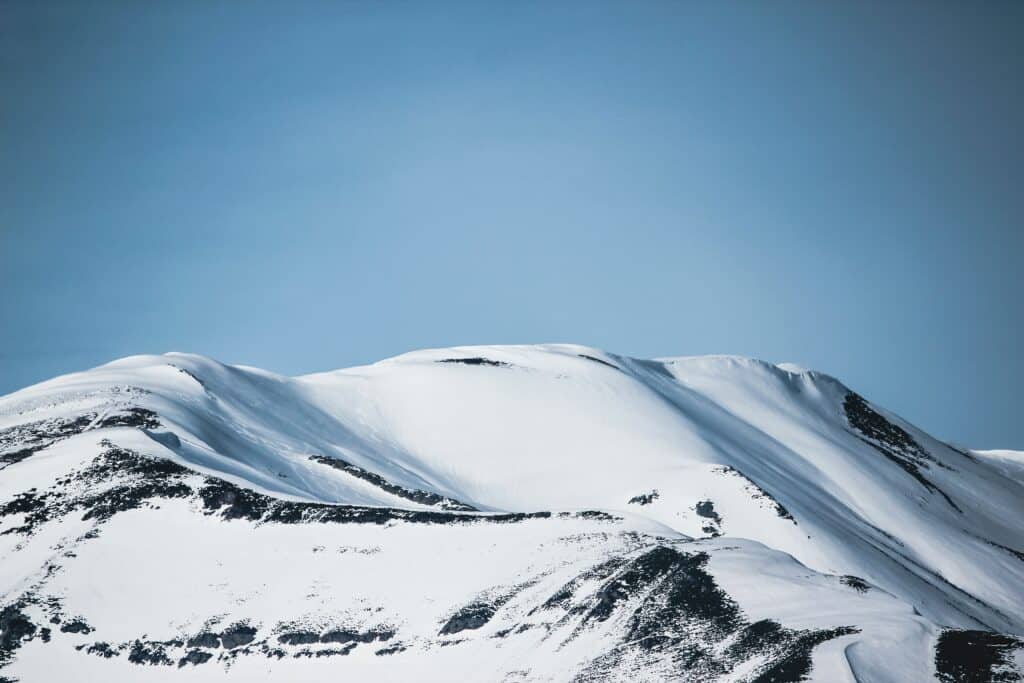
Snow in Spain
- Yes, it does snow in Spain. The amount and how cold temperatures get depends on which region you visit.
- The areas where there are oceanic and mountain climate zones receive the most snowfall.
- Spain has five different climates within its border.
Spain’s Five Climates Zones
Spain, which sits on the Iberian Peninsula and is the only European country to share a border with Africa – bounded by Morocco – is one the most climatically diverse countries in Europe.
Its diverse weather from region to region, food, and history brings many visitors to Spain.
Spain has an astounding number of climate zones (13!), with five of them being the most influential on regions.

Below, we describe the five climates to give you a better idea of what you’ll get if you visit Spain during the winter months, from November to March.
Continental Climate
Spain’s most dominant climate is continental. It affects most of Spain, except for its coast and mountain ranges.
Winters are cold enough for snow. Summers are hot. Most of the rainfall occurs in late Spring.
Mediterranean Climate
Includes southern and south-eastern coasts, including the entire southern region of Andalusia. A small but popular destination in Spain.
Winters are mild, with little to no snow. Summers vary in intensity depending on the region. Temperatures are moderate.
Oceanic Climate
Spain’s northern coast and the northwestern region of Galicia. The beautiful green landscapes of northern Spain are due to extensive rainfall from the oceanic climate zone.
Summers are warm but not hot. Winters are not as cold as the continental zones but do receive snowfall.
Areas with an oceanic climate are most frequented with snow during winter months.
These regions include Navarre, Cantabria, Basque Country, Galicia, and Asturias. Other areas may also experience snow, although these five are the most common.
Mountain Climate
As the name implies, the mountain climate can be experienced in the mountains of Spain, such as in Granada’s Sierra Nevada and mountain ranges in the northeast, northwest (Pyrenees), Midwest, and southeast (Cordillera Betica).
These areas experience mild summers and cold winters.
Temperatures fall below freezing. Snow is common and consistent in this region.
Arid Climate
Most of Murcia and a small corner of Andalusia in Spain’s southeast in Almeria.
This climate is hot and dry, with very little rainfall and no snow.

- Along the coast of Spain, the climate has mild summers and cool winters.
- Inland the climate is temperate, with hot summers and cold winters.
The Seasons in Spain
Like parts of the US, Spain enjoys four seasons: winter, spring, summer, and fall.
- Spring – March to June
- Summer – June to September
- Fall – September to December
- Winter – December to March
Is There Snow at Christmas in Spain?
Yes, it snows during Christmas in Spain, but only in the mountain and oceanic climates.
Occasionally you get snow in cities like Madrid, but rarely. And it doesn’t stay on the ground for very long.
Where To See Snow in Spain?
The Pyrenees
The mountain climate zone allows for snow in the Granada’s Sierra Nevada and mountain ranges in the northeast, northwest (Pyrenees), Midwest, and southeast (Cordillera Betica), with mild summers and cold winters.
Snow is common in this region during winter when temperatures are below zero degrees.
The Pyrenees has the highest peak in Spain. It sits on the border with France and is one place you can find snow in France and snow in Spain for an average of six months each year, starting in October and lasting through March. The Pyrenees receives 26 days of snowfall per year.
Regions with Oceanic Climates
Navarre, Cantabria, Basque Country, Galicia, and Asturias – regions with an oceanic climate – are most frequented with snow during winter.
Other areas may also experience snow, although these five are the most common.

When Does it Snow in Spain?
Like in parts of the US, winter in Spain takes place between November and March, but officially per the European calendar, winter starts on December 21 and ends on March 20.
Snowfall varies per region. From December to April, there will be snowfall in Spain’s mountain and oceanic regions.
January is the coldest month in Spain, with temperatures falling below freezing, and the mountain regions are covered with a thick layer of snow.
Snow in Barcelona
Heavy snowfall in Spain’s major cities, like Barcelona, is infrequent. That doesn’t mean it hasn’t happened.
Barcelona can get a few hours of snow during winter, but it melts within 24 hours.
A storm dubbed “Beast of the East” in February 2018 brought traffic and other activities to a standstill in Barcelona because the snowfall covered major roads for days.
This is unusual for this climate region.
Snow in Madrid
January gets an average low of 43ºF, but the nights can be freezing because Madrid sits at a high altitude surrounded by snowy mountains.
Late December and January sees some snow, but not much. Snow falls in Madrid but doesn’t stay on the ground for long.

Lugo is another very cold city in January, with temperatures below freezing.
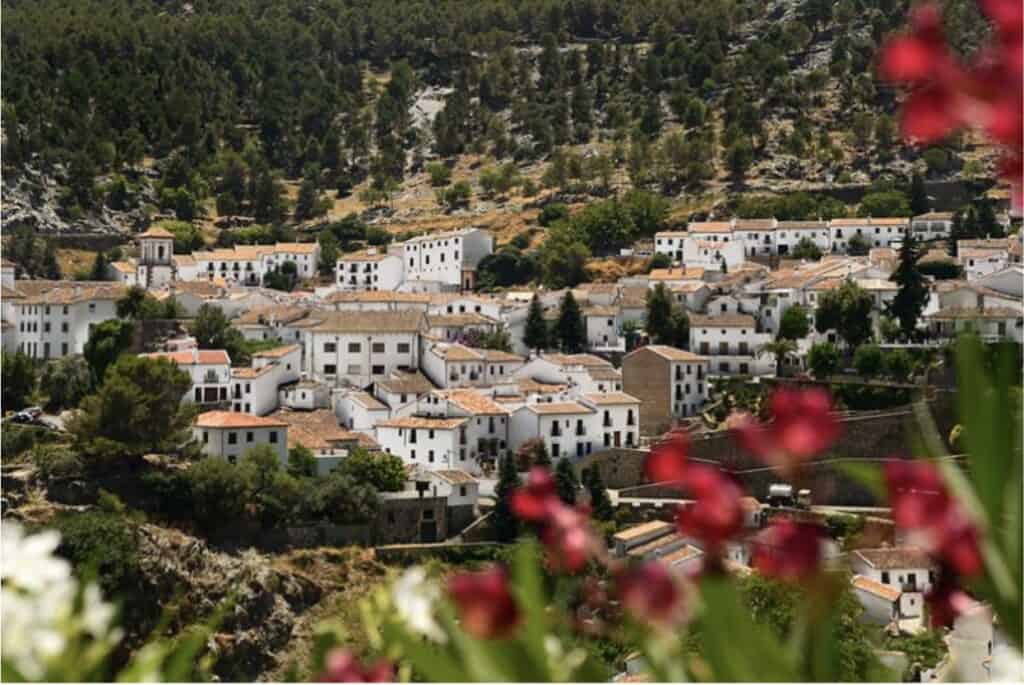
Best Places to Visit in Spain During Winter – Winter Activities
Skiing and winter hiking are two cold weather activities to enjoy in beautiful Spain. There are plenty of mountains to ski and valleys to hike along.
Spain provides 1,157 kilometers of slope for winter-sport activities.
Val d’aran (Lleida)
One of Spain’s prettiest places to see snow is the valley of Arán, located in the Spanish Pyrenees.
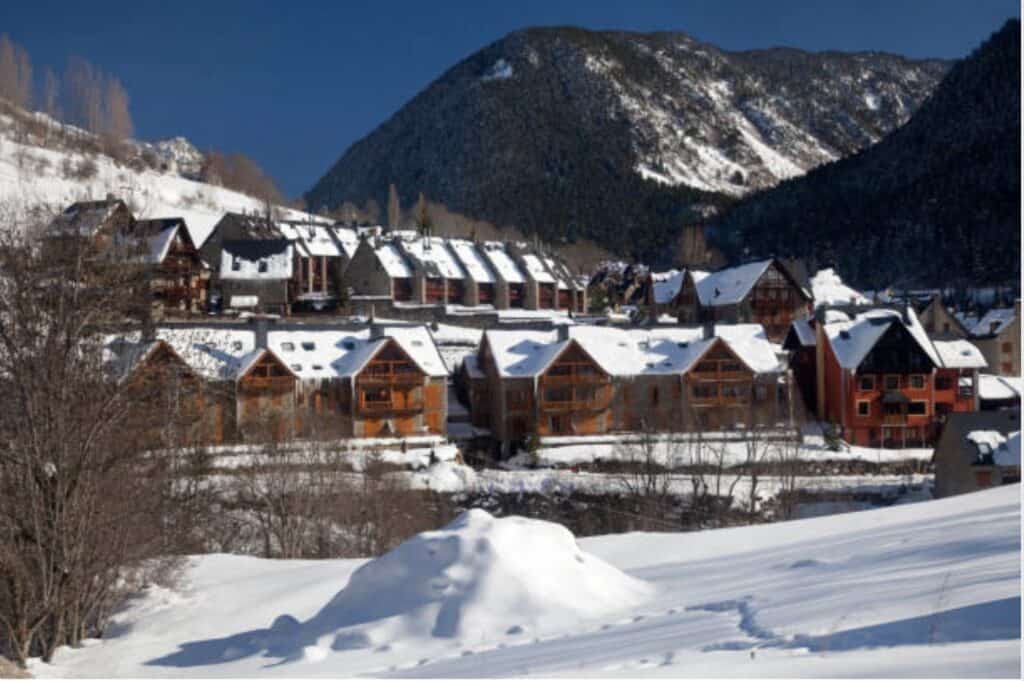
Arán is an administrative entity in Catalonia, Spain, consisting of the Arán Valley. The 240 sq. miles sits in the northwestern part of the province of Lleida.
Here you’ll see small waterfalls engulfed in high snow-capped mountains.
Val d’aran offers skiing, hiking, restaurants, and a natural hot spring.
Skiing in Spain
Baqueria Beret Ski Resort
Baqueria Beret, one of Spain’s best and most traveled ski resorts, is located in Valle de Arán.
Located in the heart of the Pyrenees in Lleida, Catalonia, Spain, with the nearest airport in Toulouse, France, approximately a two-hour drive by automobile.
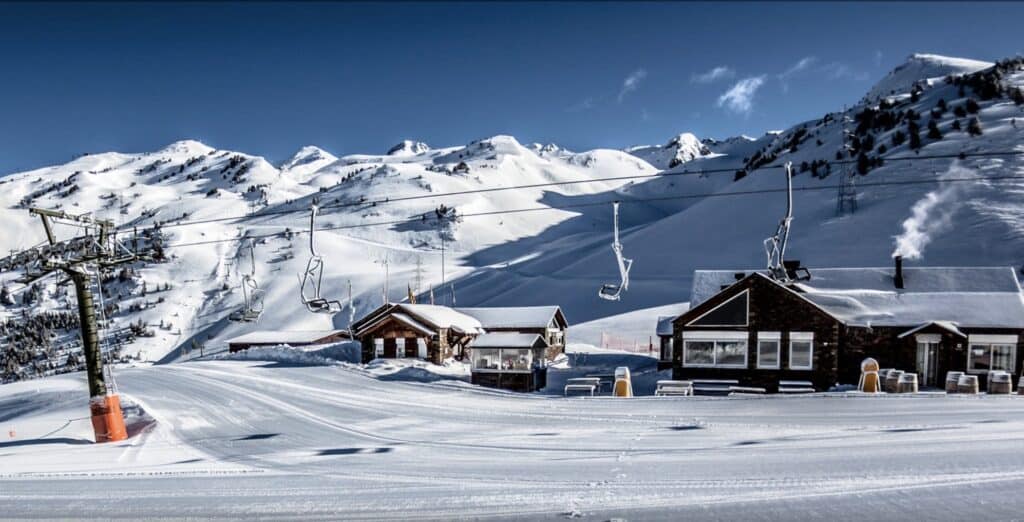
The Baqueira Beret ski resort is one of the most well-known in Spain. It is also one of the largest ski resorts in the Pyrenees, with a whopping 29 lifts to different trails.
It is considered one of the best places to ski in Spain.
The ski season in Spain begins in November and ends in April. Baqueira’s season starts in December and runs through the end of April.
Hiking in Spain During the Winter Season
Sierra de las Nieves, Malaga
Málaga is located in the southern part of Spain and there are a few reasons to visit this small town surrounded by beauty.
About an hour and a half drive from Málaga is the beautiful natural park Sierra de las Nieves.
An excellent place to take a short day hike along the coastline, surrounded by the beautiful snow-capped mountains.
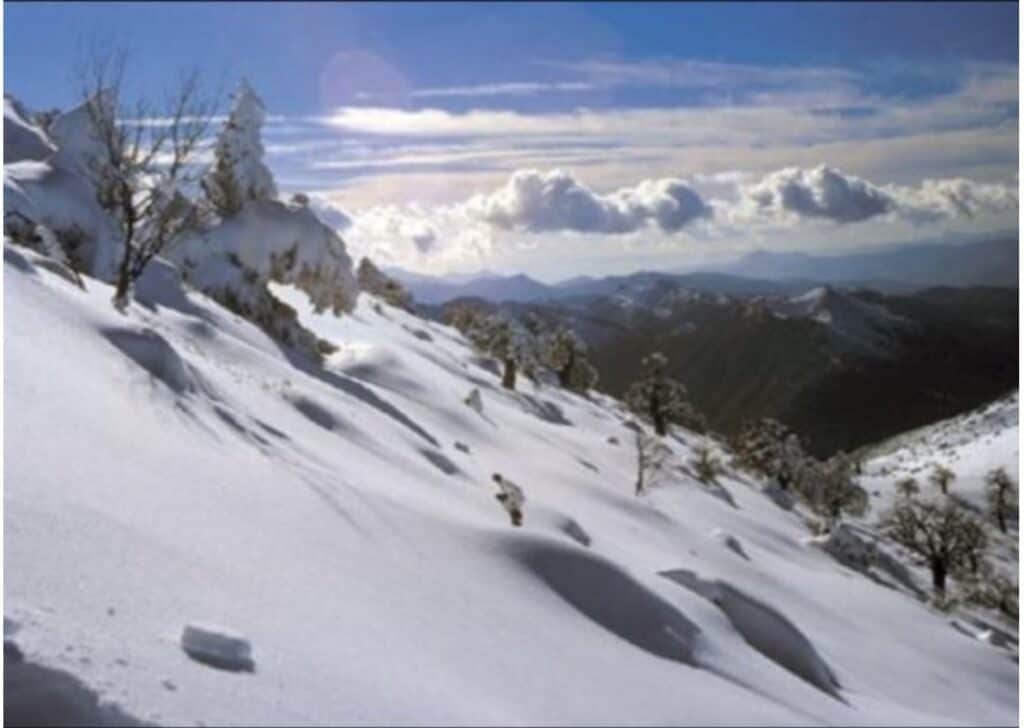
You can then head to the town to check out one of the best Christmas displays with a market that will warm your heart in Málaga.
Christmas Markets
We love all things Christmas, so in every town or city we visit, we try to pick up an ornament for the Christmas tree, which acts as a small reminder each year of the different places we’ve seen as we take them out of storage and hang them on our tree.
We’ve written about France’s Christmas Markets as well.
Like Germany and France, Spain has festive markets that pop up Christmas stalls yearly.
Below we’ve listed a few:
Fira de Santa Llúcia in Barcelona
Barcelona’s fantastic Christmas market lasts from November 25 to December 23.
Located on Avinguda de la Catedral Fira, Barcelona boasts a whopping 287 stands, so you can find a Christmas gift for everyone on your list.
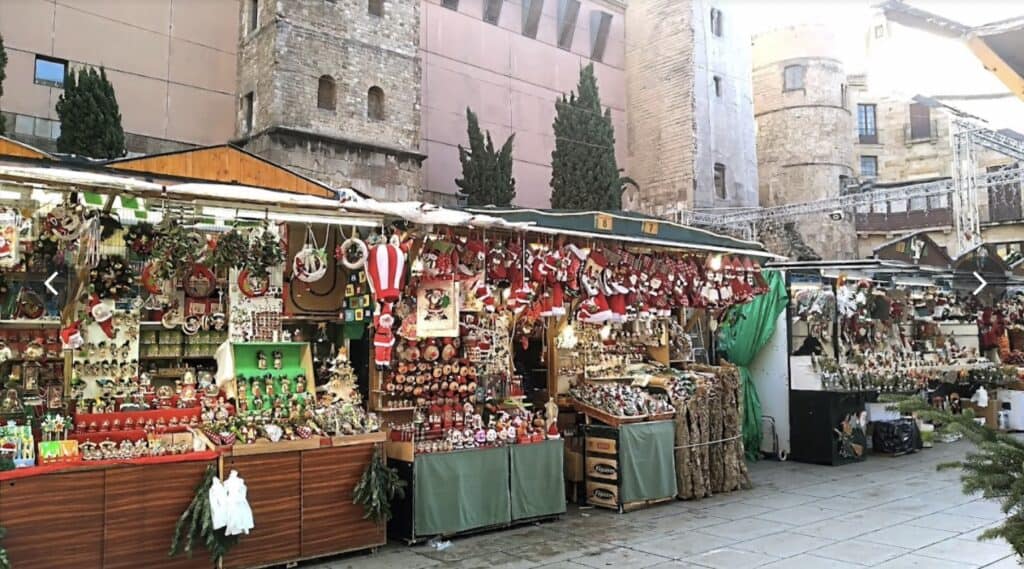
Madrid’s Christmas Market
Christmas Market in Madrid’s main square runs from November 25 to December 31.
Madrid’s Christmas Market has over 12,000 items, such as collectibles, art, antiques, and vintage pieces.
One hundred four stalls are surrounded by nativity scene figures, musical instruments, and toys.
Take in the beautiful Christmas lights that decorate the city as you shop the many vendors.
Christmas Lights in Málaga
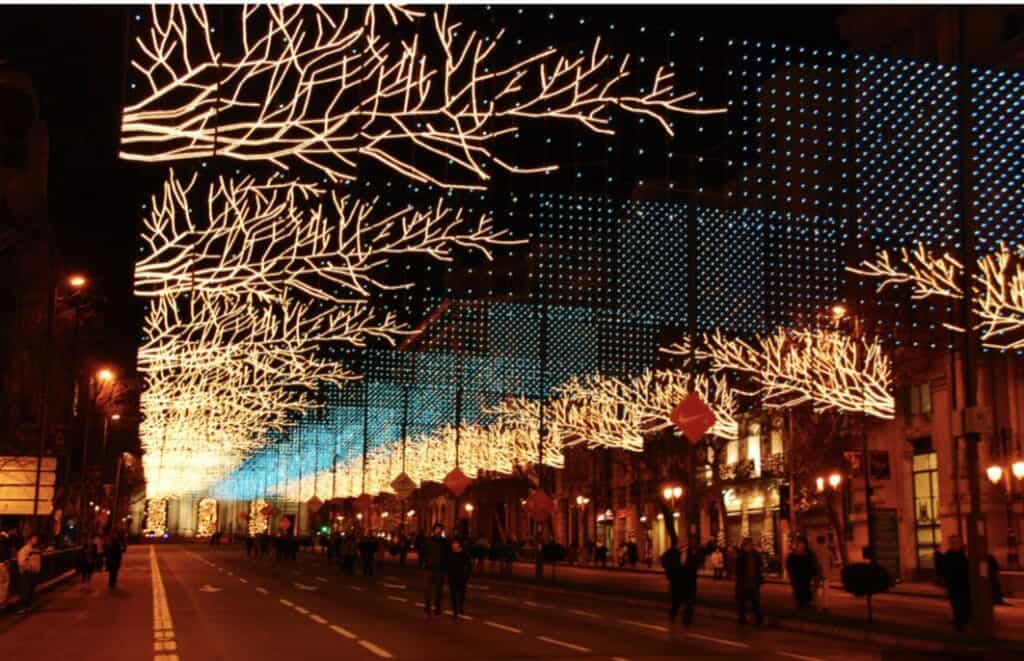
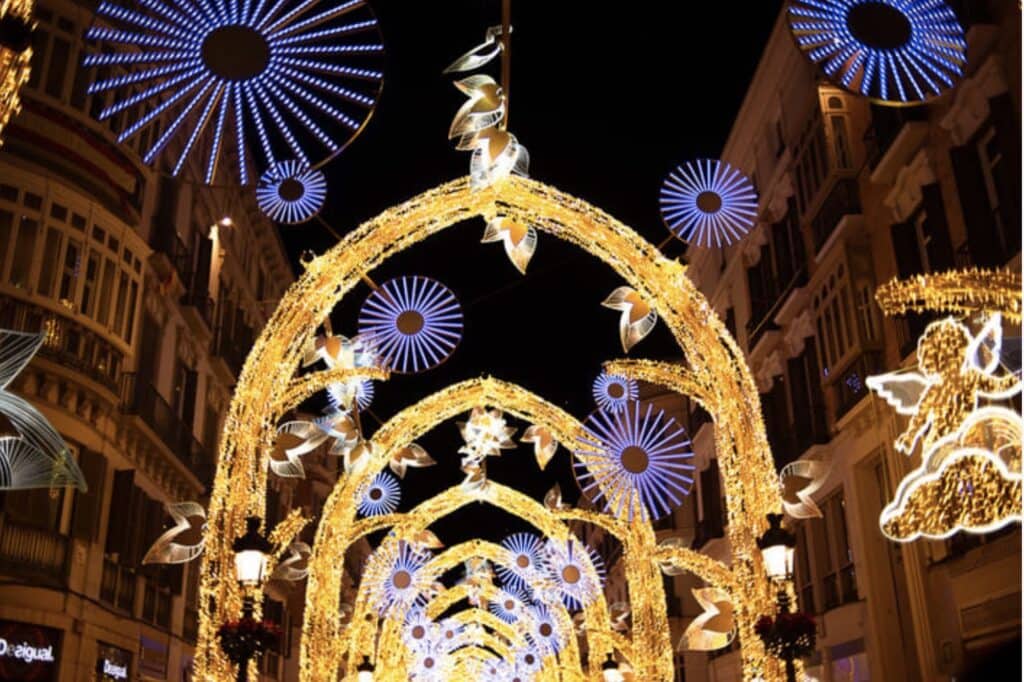
Málaga is famous throughout Spain for its stunning illumination of Christmas lights in the heart of Málaga at Calle Larios.
It’s worth a visit during the winter months for their Christmas festivities, as well as for being a short drive from Sierra de las Nieves, a national park great for a winter hike.

The illumination usually starts the last Friday of November and runs through January 5.
The Christmas market isn’t very big, but the quality of its Christmas lights is one of the most beautiful Christmas scenes in Europe.
Each year there is a ceremonial turning on the Christmas lights as visitors and residents wait on Larios street for the ceremony to begin.
Thousands of poinsettias, wickerwork figures, a giant Christmas tree, nativity scenes, and thousands of lights line the streets of Málaga.
Daily light and musical performances in the town center captivate those who gather. It’s a magical time in Málaga each year.
Light shows accompanied by Christmas music start at 6:30 pm, 8 pm, and 9:30 pm.
In Sum: Does it Snow in Spain?
Yes. It does snow in Spain. Most of us think of a temperate Mediterranean climate with balmy beach days when we think “Spain!” but some regions of Spain get a lot of snow during winter.
So, pack accordingly if you plan to visit this beautiful country during the winter season.


